
Scale insects are an elusive type of pest that can be difficult to treat, due to their ability to imbed into a plant and produce a waxy protective covering over themselves, along with a sweet secretion. This crazy combination of abilities is what leaves both normal folks and pest controllers scratching their head in wonder.
If you’re wondering how to get rid of scale insects, would like to know more about scale insect control and natural treatments for scale insects, you’ve come to the right place.
Read on!
Table of Contents
- Scale Insect Identification
- Scale Insect Damage on Plants
- How to Get Rid of Scale Insects
- Scale Insect Control/Treatment
- Natural Treatments for Scale Insects
- Conclusion & Next Steps
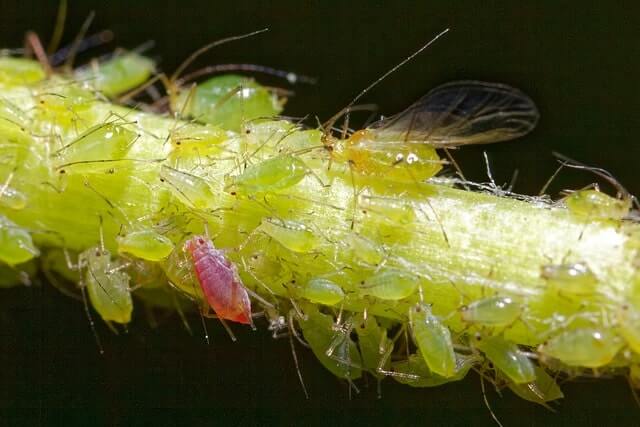
Scale insects are very tiny, similar to aphids (pictured here). They congregate on plants and secrete a sweet substance that can attract other pests.
Scale Insect Identification
Scale insects are very small insects in the same order as aphids, and they can be just as destructive to plants as aphids.
Scale insects are herbivores, piercing plant tissues with their mouth parts. They remain in one place and feed on the sap. They secrete excess fluid, which can smell similar to honeydew. It is a sweet scent, and it attracts many other pests, like bees, hornets, wasps, but sometimes even animals and rodents that like honey.
This secreted sweet substance that attracts other pests is not the only issue with scale. Their secretions also tends to grow a sooty mold, which can damage the plants of which the scale insects are feeding.
The scale insects do, however, have a mutualistic relationship with ants, which feed on the honeydew-like substance and protect the scale from predators. Different scale insects pose a more serious pest threat than others. For example, there is a cottony cushion scale (primarily in the south/more tropical climates) that have a waxy covering protecting them from all contact insecticides. This is a more commonly looking scale infestation we see in Minnesota and Wisconsin.
Most scale insects have a wax covering, and some are even shaped like oysters or mussel shells, while others simply look like little pearls.
However scale look, they are very difficult to get rid of as pests. Learn more about how to get rid of scale insects and scale insect damage on plants below.
Scale Insect Damage on Plants
Scale species are a considerable crop pest, which have caused around $5 billion of damage to farmers in the late 1900s. Their waxy coverings make them immune to contact insecticides, which are most pest controllers main defenses.
Like forest tent caterpillars, and other invasive species (even the Emerald Ash Borer Beetle) or drought pests in general, can cause serious damage to trees, bushes, and other yard foliage as well. It can even kill them in a drought.
How to Get Rid of Scale Insects
Due to their waxy protective covering, it is best to think outside of the box when it comes to getting rid of scale insects. Some types of oils, such as horticultural oils, can suffocate them.
Some systemic pesticides poison the sap of the host scales. But, if you catch the scale quickly, contact insecticides are effective against the first-instar nymph stage, also known as the “crawler” stage.
A licensed pest controller should have access to a variety of types of commercial-grade products that can stop scale in its tracks. Otherwise, you’re welcome to try an oil or pesticide yourself. Check out more information for treating scale insects on your own under the section natural treatments for scale insects.
Scale Insect Control/Treatment
The National Pest Management Association magazine has a section called Ask the Expert. A few years ago someone asked a question regarding several bushes surrounding a structure where scale were drawing ants. This company would get a lot of ant callbacks and it took a bit for them to figure out what was going on.
This isn’t rare — scale insects have been called cryptic by many, and easy to miss.
The pest control expert responded with some optional treatment methods, including a root drench and a foliar applications.
The root drench treatment is done early in the season with a chemical pesticide. Then later in the year a foliar application is completed, which means a spray of the plant’s leaves and stems and such. This second option is never recommended if the plant is an edible plant.
Depending on the severity of the issue, the scale can last a few year and take a few years of treatment. If one uses any pesticide or insecticide, it is also recommended to use an Insect Growth Regulator.
Natural Treatments for Scale Insects
The best recommendation for scale insect treatment Done Right Pest Solutions could offer is Captain Jack’s Neem Max, which uses neem oil and ensures that the bush or plant is not harmed, and neither any fruit if an edible plant.
Folks will also need a sort of brush, perhaps a toothbrush, depending, to scrub the scale insects off of the plant stems.
Another option is insecticidal soap.
For tips and tricks, you’re always welcome to call the pros at Done Right Pest Solutions! 651-342-9489.
Conclusion & Next Steps
At the end of the day, there will always be some elusive pests that confuse normal folks and pest controllers alike. One of these elusive pests is scale insects. We hope you know and understand a bit more about these hard-to-treat pests, and some natural treatments for scale insects.
If ever you need anything pest control-wise, we hope you’ll contact us. You’re welcome to email us at donerightpestsolutions@gmail.com or text or call us at 651-342-9489.
We’re here when you need us,
Done Right Team